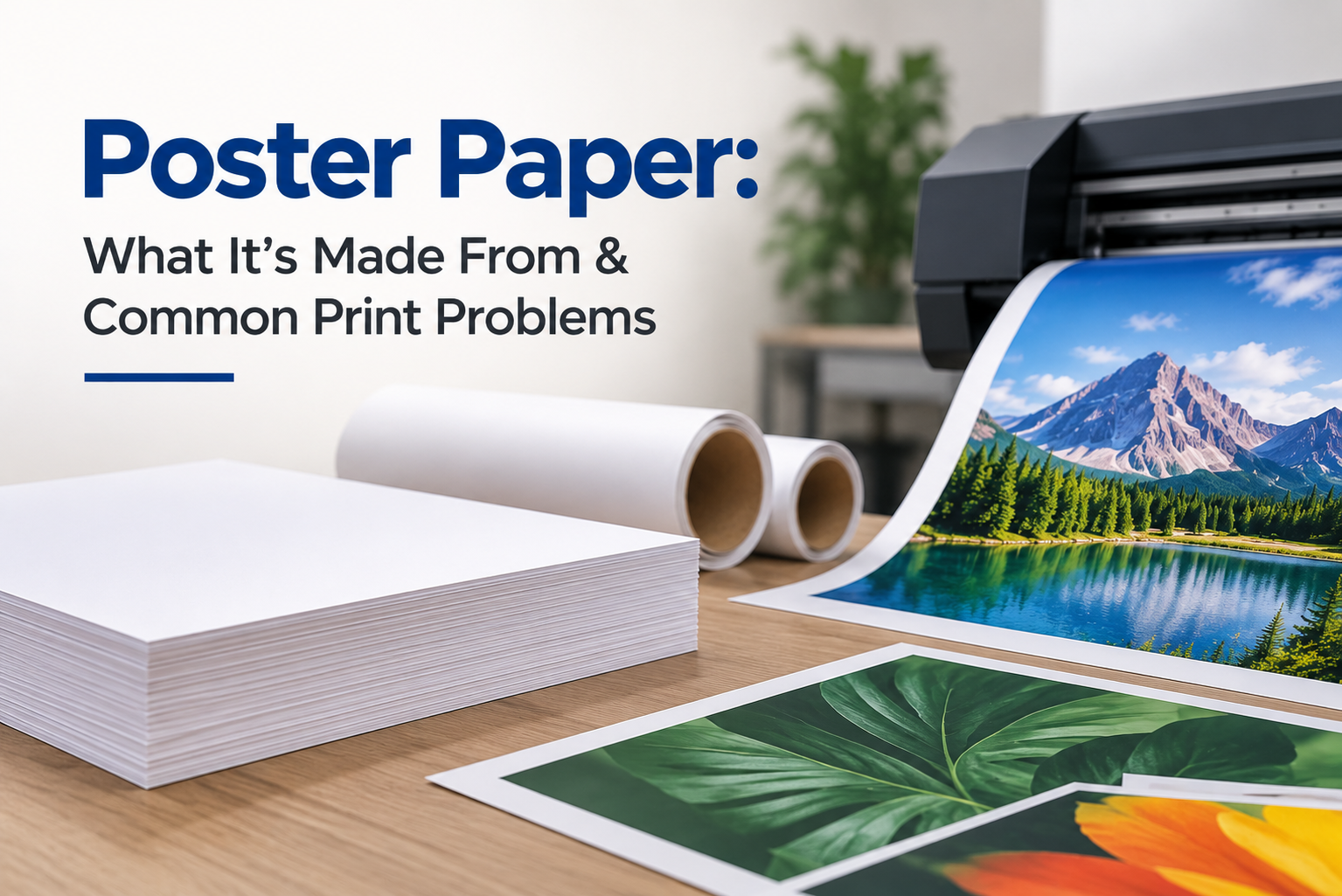
Poster paper is designed to offer performance and premium print quality. However, even high-quality paper can deteriorate or perform poorly if the storage conditions are not favorable or if they are handled incorrectly. While machine settings play a role, the condition of the paper can significantly affect print performance and cause issues such as curling, paper jams, sticky sheets, and more.
This blog helps businesses and printers understand what poster paper is made from, optimal storage conditions, and the right way of handling it, for businesses and printers to avoid production problems while reducing wastage.
What Poster Paper is Made From?
Poster paper is a durable and flexible paper made from cellulosic fibres. These fibres are the building blocks of the paper which are transformed into pulp, then pressed and dried into the final paper sheets.
Poster paper fibres can be made from virgin pulp, recycled paper, or a combination of both. Moreover, the type and quality of the fibers directly affect the strength and appearance of the final product, along with the printing performance.
Other materials may also be added during papermaking process to provide specific properties, including:
- Paper fibres: Form the main structure of the sheet.
- Virgin pulp: Provides fresh fibres for making paper.
- Recycled fibres: Come from recovered paper that is processed into usable pulp.
- Fillers: Can improve properties such as smoothness and opacity.
- Sizing agents: Help control how the paper reacts to moisture and printing inks.
- Surface treatments: Can improve the paper's surface and print performance.
Can Poster Paper Be Made from Recycled Paper?
Yes, Khatema Fibres uses recycled paper for processing poster paper after converting it into pulp. However, the quality of the recovered fibres and the process method will affect its final quality. Here, not only the fiber source is responsible for the output and performance, but other critical metrics such as pulp preparation, refining, sheet formation, drying, finishing, and quality control determine its physical properties.
How to Make Poster Paper?
Here’s the step-by-step guide to explain the processing of poster paper:
Stage | What Happens |
1. Fibre Preparation | Raw materials such as virgin or recovered fibres are prepared for papermaking. Recovered paper may be sorted to remove unwanted materials. |
2. Pulp Preparation | The fibres are mixed with water to create pulp. The pulp is cleaned and screened to remove impurities. |
3. Refining | The pulp is processed to improve the way fibres bond together, helping provide the required strength and sheet formation. |
4. Sheet Formation | The pulp is spread onto a forming surface, where much of the water is removed and the fibres form a continuous sheet. |
5. Pressing | The wet sheet is pressed to remove more water and strengthen the fibre network. |
6. Drying | The sheet is dried under controlled conditions to achieve the required moisture level and paper properties. |
7. Finishing & Converting | The paper may receive surface treatments before being cut into sheets, wound into rolls, or converted into the required format and packed. |
How Does Moisture Affect Poster Paper?
Moisture is one of the most significant factors that affect the performance of poster paper.
Actually, the paper is hygroscopic, which is why it naturally exchanges moisture with the environment and is easily affected by the changing humidity levels. It can release or absorb moisture, causing dimensional changes and affecting its performance during printing.
With uneven moisture levels users can witness the following flaws in paper:
- Curling
- Waviness
- Edge deformation
- Sheets sticking together
- Feeding problems
- Static-related issues
- Changes in print performance
Most Common Poster Paper Printing Problems
Printing problems can have several causes, including paper condition, environmental conditions, machine settings, or equipment issues.
Printing problem | Possible paper-related cause | What to check |
Paper curling | Moisture imbalance or heat exposure | Storage conditions and paper condition |
Paper jams | Curling, damaged sheets, unsuitable media | Sheet condition and machine specifications |
Wavy sheets | Excess moisture | Packaging and storage environment |
Sheets sticking together | Humidity or static | Moisture exposure and handling |
Wrinkles | Damaged paper or feeding conditions | Edges, storage and machine path |
Uneven feeding | Curling or damaged edges | Flatness and sheet condition |
Inconsistent print quality | Surface or moisture variation | Paper condition and print settings |
Procure High Quality Poster Paper for Consistent Printing
Khatema Fibres offers quality paper solutions designed to support reliable printing and converting performance. Businesses can consider our platform for:
- Consistent Quality: Paper manufactured to maintain uniform specifications across batches.
- Reliable Strength: Suitable for printing, handling, and converting requirements.
- Print-Friendly Surface: Designed to support clear and consistent print results.
- Multiple Specifications: Options can be selected according to GSM, size, and application requirements.
- Bulk Procurement: Suitable for businesses with regular or large-volume paper requirements.
- Quality-Focused Manufacturing: Emphasis on fibre quality, sheet consistency, and overall paper performance.
Conclusion
The quality and performance of poster paper depend on its manufacturing process and finishing. However, common moisture-related issues like curling, sticking, jams, and uneven printing are caused by unfavorable storage conditions and handling. These issues can cause waste and inconsistent paper quality across batches. Businesses can resolve them by maintaining suitable storage conditions and using compatible printing settings.