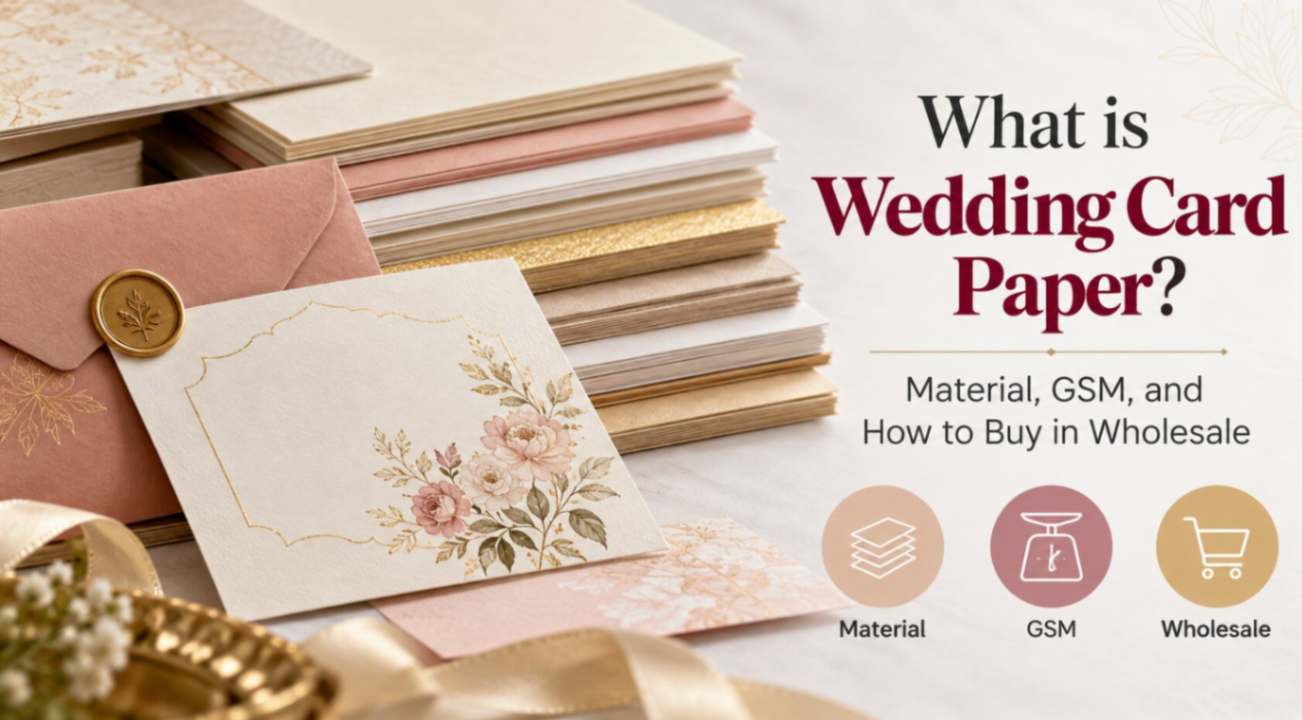
Wedding card paper is manufactured using a combination of different papers and board materials to create its different sections, including the envelope, main card, and other decorative layers, which affect the appearance and feel of this invitation card. Buyers have to decide which GSM paper they need to procure based on the design and number of layers their wedding invitation card has.
Bulk buyers such as wedding card manufacturers and printers compare factors like sheet size, GSM, finish, price, printing quality, and more before procuring it. This guide explains all about wedding card paper, its types, the right GSM, material quality, and how to buy in bulk.
What Is Wedding Card Paper?
Wedding card paper is the paper or board selected to make wedding invitations and their supporting components. It can range from coated art paper and art card to textured, handmade, metallic, kraft and specialty papers.
A complete wedding invitation may use more than one paper type:
- Main card: The primary invitation, usually made from a relatively stiff paper or board.
- Insert: Used for venue details, RSVP information, functions and other details.
- Envelope: Holds and protects the invitation.
- Liner: Added inside an envelope for a decorative finish.
- Folder or sleeve: Holds multiple cards or inserts together.
- Box: Premium invitation sets may use a rigid box or paper-covered board.
This means buyers should not select one GSM for the entire project. The paper should be matched with the function of each component.
What Materials Are Used for Wedding Cards?
Different paper materials create different levels of stiffness, smoothness, texture and visual appeal. The choice also affects printing and finishing.
Paper Type | What It Is | Feel & Finish | Best For | Watch Out For |
Art Card | Coated paper/card with a smooth surface | Smooth and relatively rigid | Main invitation cards, printed covers | Coating may affect some finishing processes |
Art Paper | Smooth coated printing paper | Clean and smooth | Inserts, covers and detailed printing | Usually less rigid than card stock at similar applications |
Maplitho | Uncoated printing paper | Natural, writable surface | Inserts and information cards | Less premium surface than coated stock |
SBS/FBB Board | High-quality paperboard used for packaging and print applications | Smooth and stiff | Premium cards, folders and boxes | Cost can be higher |
Duplex Board | Multi-layer board with different surface characteristics | Firm, available in different finishes | Folders, backing and budget applications | Surface and print quality vary by grade |
Handmade/Cotton Paper | Paper made with natural fibres and often handmade textures | Soft, textured and distinctive | Premium, artistic invitations | Higher cost and variable surface |
Textured/Linen Paper | Paper with an embossed or textured surface | Linen, laid or decorative texture | Premium invitation covers | Fine details may print differently |
Metallised/Foil Paper | Paper with metallic-looking surface | Shiny or reflective | Decorative cards and accents | Printing and finishing need testing |
Vellum | Thin, translucent specialty paper | Semi-transparent | Overlays, wraps and inserts | Can require careful handling |
Kraft Paper | Brown or natural-looking paper made for strength and a rustic appearance | Natural and earthy | Rustic invitations, envelopes and sleeves | Dark surface can affect colour reproduction |
Seed Paper | Paper containing plantable seeds | Natural and textured | Eco-focused invitations and inserts | Printing and finishing options can be limited |
What GSM Is Best for Wedding Cards?
GSM means grams per square metre and is one of the specifications used to describe paper weight. However, GSM should not be treated as the only indicator of paper quality or thickness.
For wedding invitations, the suitable GSM depends on the component and the desired construction.
Card Component | General GSM Range to Consider | Typical Requirement |
Main invitation card | 250–350 GSM | Firm enough for the primary card |
Premium/luxury card | 350–450 GSM | More substantial feel |
Insert | 100–180 GSM | Easier to print, fold and handle |
Envelope | Around 100–135 GSM | Flexible enough for folding and sealing |
Envelope liner | 80–120 GSM | Lightweight decorative layer |
When Is Heavier Paper Not Better?
A higher GSM does not always mean a better wedding invitation.
Very heavy stock can:
- Increase the total weight of the invitation set.
- Increase postage or courier costs.
- Make folding more difficult.
- Require special scoring before folding.
- Create feeding issues on some digital printing equipment.
- Increase material costs.
How Does the Printing Method Change the Paper Choice?
The printing process should be considered before ordering wedding card paper. A paper that performs well in offset printing may not give the same result on another printing process.
Printing/Finishing Method | Paper Consideration |
Offset printing | Check surface, ink absorption, and sheet stability |
Digital printing | Confirm that the GSM, coating, and thickness are supported by the printer |
Screen printing | Test ink adhesion and surface compatibility |
Foil stamping | Surface should support the required foil and pressure |
Embossing | Paper should have sufficient fibre strength and suitable thickness |
Letterpress | Softer fibre-based papers can create a deeper impression |
Laser cutting | Test for scorching, curling, and edge quality |
How to Buy Wedding Card Paper in Wholesale?
Buying wedding card paper wholesale is not as simple as selecting a new design. It includes considering various aspects like sheet size and specifications along with price range.
Procurement Per Size or Weight
Paper may be quoted by:
- Sheet
- Ream
- Kilogram
- Bundle
- Reel
- Pack
In which form a supplier sells depends on the type of paper and minimum order quantity.
Check Common Sheet Sizes
Sheet size has a direct impact on cutting efficiency. Common commercial sizes may include 23 × 36 inches and 20 × 30 inches, although availability varies by paper type and supplier.
Check Minimum Order, Samples and Lead Time
Ask the supplier:
- What is the minimum order quantity?
- Is a sample available?
- Is the quoted price valid for the required quantity?
- What is the production or dispatch lead time?
- Is the paper available from stock or made against order?
- Can the same shade and specification be repeated for future orders?
Check Major Specifications
Ask for a specification sheet where applicable. It should ideally identify details such as:
- GSM
- Sheet size
- Paper/board grade
- Finish
- Colour or shade
- Quantity
- Packaging
- Batch information
Why Choose Khatema Fibres for Buying Wedding Card Paper?
Khatema Fibres is a leading paper manufacturer and supplier in India. Their vast product range also includes wedding card paper offering high strength and high print quality. If you are looking for reliable paper solutions for wedding stationery projects, explore Kraft Paper, MG Poster Papers, and Gift Wrap Tissue at competitive prices. By choosing us, you will get the benefit of:
- Custom GSM and sizes
- Bulk supply support
- Multiple paper options
- Consistent quality
- GST invoicing
These options make it easier to source the right paper for different wedding stationery requirements while maintaining consistent quality across bulk orders.